
You are probably paying for more NetSuite than you are using.
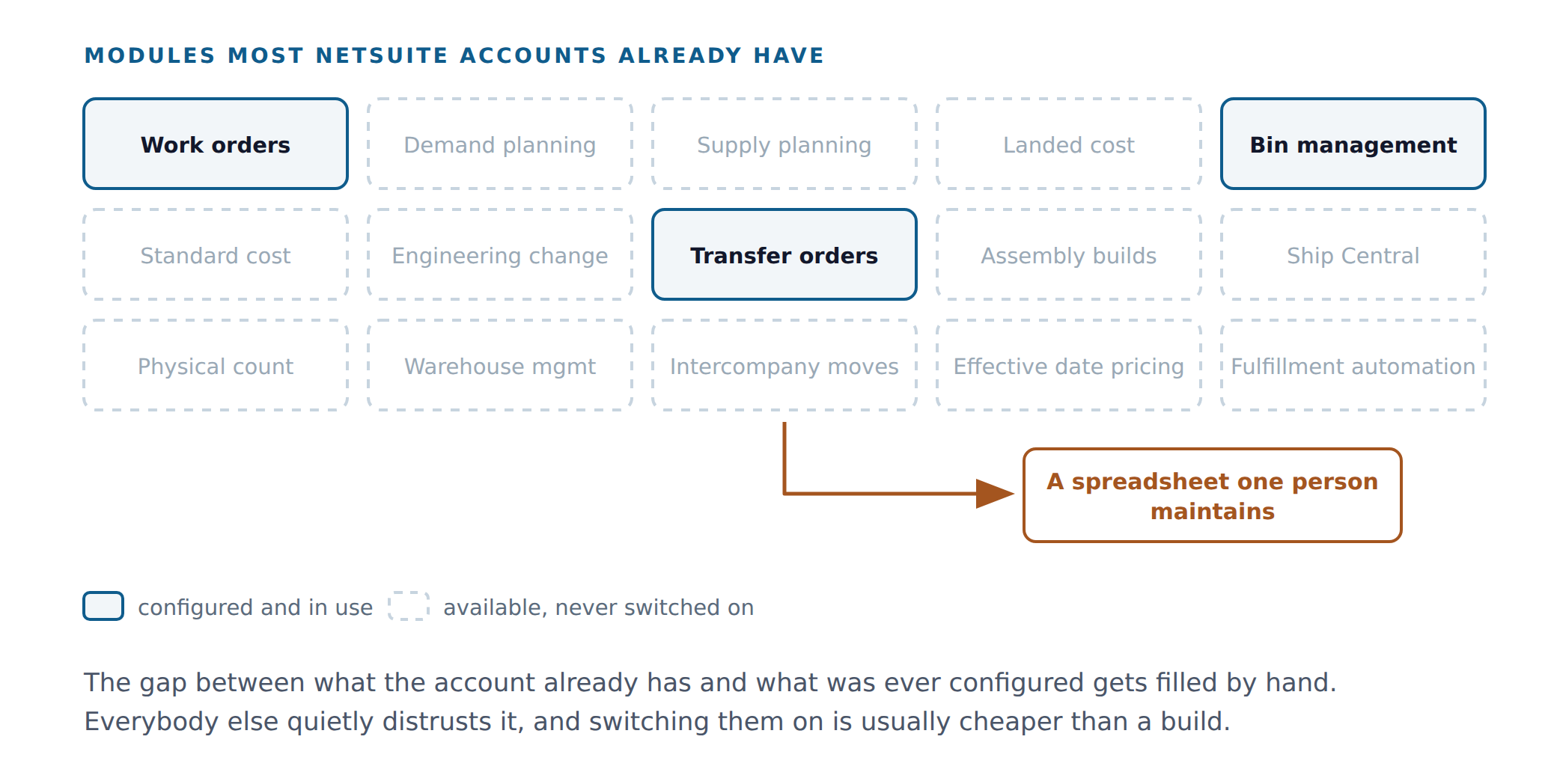
Demand planning, supply planning, bin management, landed cost, engineering change orders, warehouse management — most of it is already in your account. The license covers it, nobody ever configured it, and the gap gets filled by a spreadsheet that one person maintains and everybody else quietly distrusts.
This practice is the unglamorous work of switching those on properly and making them match how your business actually runs. It is usually cheaper than what you were about to spend, and it is almost always the first thing to check.
What we do
Orders Order management configured for how you sell — including the marketplace channels beside your own store. Shopify and Amazon orders into NetSuite through NetSuite Connector, so the channel that sells is not the channel that owns your data.
Inventory Inventory and bin management. Transfer orders and multi-location moves, including the intercompany kind across subsidiaries. Landed cost, so freight and duty end up in the item cost rather than in a variance nobody reconciles. Standard cost maintenance. Physical inventory count design — sequencing, variance handling and reconciliation back to the ledger.
Planning Demand planning and supply planning. This is the one companies most often own and never use: purchasing run off a forecast in a spreadsheet that nobody fully trusts, while NetSuite sits there able to do it. Getting planning working is frequently the highest-value configuration project available to a distributor or manufacturer.
Manufacturing and assembly Work orders and assembly builds. Engineering change orders. Effective date pricing. Manufactured-versus-purchased analysis to support sourcing and make-or-buy decisions.
The warehouse Warehouse management and Ship Central — carrier and bill-of-lading capture on the mobile devices, carton visibility, bin replenishment at pick time. Fulfillment automation for high-volume order processing.
And the honest part Sometimes a module genuinely will not do what you need, and the answer is something built. We will tell you which situation you are in before you spend anything, not after.
What that looked like
Planning taken off the spreadsheet. [client name pending] Demand and supply planning configured against real lead times and real behavior, replacing a purchasing forecast maintained by hand.
Inventory that could finally be counted. [client name pending] A Map/Reduce inventory snapshot across four location groups and more than 6,800 records — component resolution through bills of material, multi-warehouse rollup, and a physical count process designed around it.
Intercompany transfers that ran themselves. [client name pending] Transfer order automation from assembly builds across four subsidiaries, supporting both cost-based and dealer transfer pricing.
Serial numbers at the handheld [client name pending] Capture at pick on WMS devices, validation at scan, and a closed return loop — without turning on serialized inventory and everything that comes with it.
Where we usually get called in
- Inventory never quite matches the count, and nobody trusts the number
- Purchasing runs off a spreadsheet forecast that one person maintains
- Transfer orders and multi-location moves are done by hand
- Work orders and assembly builds do not reflect what actually happens on the floor
- Freight and duty are not in item cost, so margin is wrong and nobody can say by how much
- The warehouse team works around NetSuite rather than in it
- Marketplace orders arrive somewhere other than NetSuite
- Someone has quoted a custom build for something you suspect the system already does
Common questions
How do we know whether we already own a module? Ask us and we will look. It takes very little time, and it is the single most common way we save a client money in the first hour. Licensing changes, features get added at releases, and most companies have never audited what is actually available to them.
Is NetSuite’s demand planning any good? It is good enough for most mid-market distributors and manufacturers, and considerably better than the spreadsheet it usually replaces. It needs real setup — lead times, safety stock, supply and demand rules that reflect how you actually buy — and that setup is the work. Turned on without it, it produces confident nonsense.
Do we need WMS, or is bin management enough? Often bin management plus some process is enough, and WMS is a bigger commitment than people expect. It depends on volume, on whether you are scanning, and on how much your warehouse currently works around the system. We will give you a straight answer.
Do you actually need serialized inventory? Usually not. Most companies asking for it want to know which unit went to which customer, which is a much smaller problem and a much smaller bill. We have written about the alternative in detail.
We sell on Amazon and Shopify. Where does that fit? Here, for the orders and inventory side — NetSuite Connector moves the data without touching your website. The settlement and reconciliation side sits under finance and accounting operations.
Can you work with our third-party logistics provider? Yes. Getting a 3PL’s shipment data into NetSuite as item fulfillments, so invoicing follows automatically, is a job we have done — it usually needs a custom integration rather than configuration.
How to start
The first hour is free. Bring the specific thing — the count that never reconciles, the purchasing spreadsheet, the quote you are not sure about — and we will spend an hour on it with you, in your account. Written notes afterwards, whether or not you hire us.
Related reading: Closing the serial number gap in NetSuite WMS · Completing the serial number lifecycle